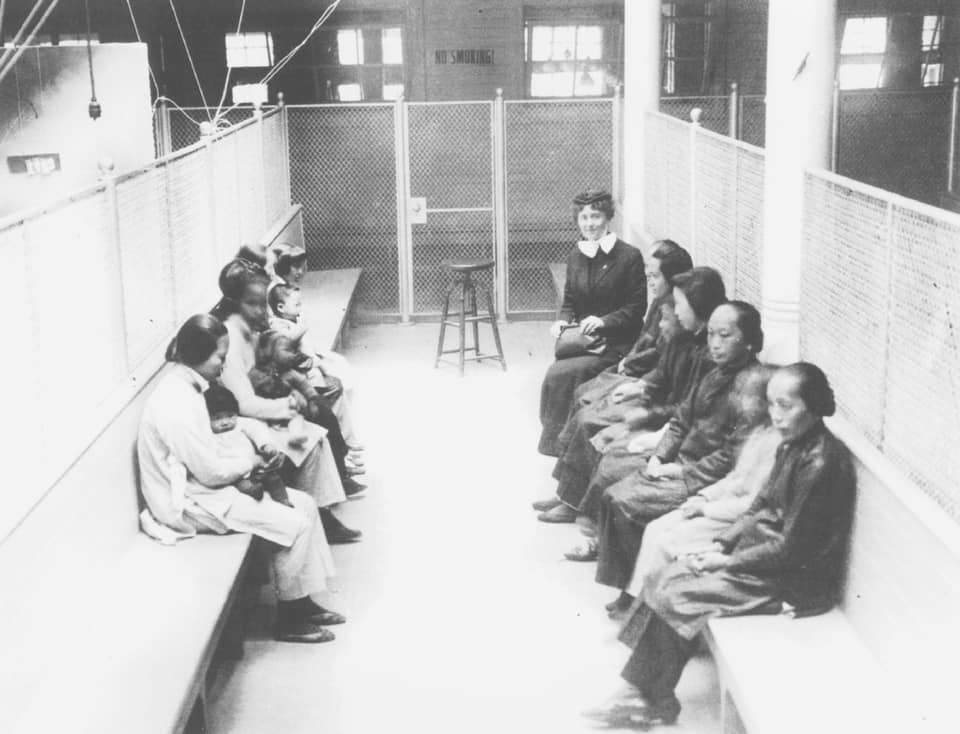
January 21, 1910: ANGEL ISLAND
The immigration station Angel Island opens in California’s San Francisco Bay, serving as the country’s major port of entry for Asian immigrants, with some 100,000 Chinese and 70,000 Japanese being processed through the station over the next 30 years.
Known as the “Ellis Island of the West” and located 6 miles off San Francisco’s coast, the island was a military reserve during the Civil War. Immigrants without proper documentation were quarantined there for days to YEARS in a “prison-like environment,” according to the National Parks Service. Closed in 1940, it’s now a California state park.
Immigrants undertook a Pacific Ocean journey of three weeks, including stops in Honolulu, Manila, Yokohama, Shanghai and Hong Kong. Many passengers could barely afford steerage class travel, and bought their tickets only with the collective help of relatives and neighbors. These new immigrants believed that they could make that money back quickly in America. Other immigrants came from the Punjab, Russia, the Philippines, Portugal, Australia, New Zealand, Mexico, and Latin America as well. Their stories are not well documented and remain waiting to be uncovered.
The station would prevent Chinese immigrants from communicating with those in San Francisco, isolate immigrants with communicable diseases, and, like the prison on nearby Alcatraz Island, be escape proof.
From 1910 to 1940 most of Angel Island’s Chinese detainees were young men between 14 and 18 years of age. Some had an elementary school education in the form of private tutoring, but they were rarely educated at the high school level. Detainees knew some classical Chinese and the ABC’s of Chinese calligraphy. However, some fairly high quality poems indicated that there were a few older and well-educated persons amidst the detainee population. The overwhelming majority of the authors of the poems did not sign their names to their poems. Only a dozen or so signed their real names. A few others included their surnames, birthplaces, and the dates of their writing.
Some of the inscriptions from the wall:
Translation:
Detained in this wooden house for several tens of days,
It is all because of the Mexican exclusion law which implicates me.
It’s a pity heroes have no way of exercising their prowess.
I can only await the word so that I can snap Zu’s whip.
From now on, I am departing far from this building
All of my fellow villagers are rejoicing with me.
Don’t say that everything within is Western styled.
Even if it is built of jade, it has turned into a cage.
Poem 135
Translation:
Sitting alone in the customs office,
How could my heart not ache?
Had my family not been poor,
I would not have traveled far away from home.
It was my elder brother who urged me
To embark on a voyage to this shore.
The black devil here is unjust-
He forces the Chinese to clean the floor.
Two meals a day are provided,
But I wonder, when will I be homeward bound?
– Lee from Toishan District, September 4, 1911
Translation:
My Wife’s Admonishment
We are poor, so you’re leaving home to seek wealth;
Keep hold of propriety while on this journey.
Never pick wildflowers along the road,*
For you have your own wife at home!
Before you depart, I admonish you a thousand times;
Don’t let my words just whistle past your ears.
Don’t worry about us, be diligent and frugal,
And two years hence return to sweep the ancestors’ tombs.
Your wife and children haven’t a thing to wear;
Not half a cup of rice can be scooped from the pot.
Our house and rooms are dilapidated;
Our housewares are worn, and the curtains torn.
In the past, you did nothing but gamble;
You never thought of me and my flowing tears.
You are fortunate your elder brother has paid the taxes-
Always remember your great debt to him!
– Lee from Toishan District, Arrived July 12, 1911
#aapi #aapiheritagemonth #asianamerican #angelisland
Further Learning:
Leave a comment