“We are looking forward to you speaking at our event soon and sharing your story.” I scroll through the next few sentences of the email to try and figure out what I’m missing. I don’t recall talking to anyone about this event, but I know I may have forgotten something. There’s no date, time, or event information included. Just a quick “thank you” and that they will send a link to discuss the event logistics with the speakers soon. Hmm. Did I completely overlook this?
I start searching through all my emails for the person who sent this information. I can’t find anything. It doesn’t seem as though I’ve had any communication about the event before today. This sort of thing happens from time to time. I receive a lot of speaking requests and have found the state of event organization varies from planner to planner. I chuckle softly at the irony of the word “organization.”
After confirming that I don’t have any additional information, I follow up with a “reply all” email copying everyone. I know that is the “everyone is now involved” of all email responses, but I wondered who else was as clueless as I was when the initial communication came through. “Good morning. I am honored to be involved in your event. Would you mind providing a few details and a bit of background as to what elements of my story you are hoping I might share? I am excited to support you and help raise awareness. Thank you.”
A short while later, I received a reply. “Our group was planning an event, and one of the organizers suggested you and expressed that you had a memorable story about your father. Here are the event details. Please let me know if you need anything else.” I wondered who may have mentioned me, as they hadn’t shared.
As I sat re-reading the email, I found myself stuck on the words “memorable story about your father.” Memories wafted through my mind for a few seconds. I smiled softly when I thought of us watching movies together in our sunroom. Then there was the time he caught me 30 feet up in a pine tree in our backyard. I remember how angry he seemed, but later, I realized it was just fear. That had been the first time I thought of him as tiny. I hadn’t told him that I had secretly been climbing the tree for a while. I knew better. Somehow, my memories always end up at sunsets on the beach. I wish I could remember how many there were. A large part of me knows it was probably only a handful of times, but they seem so significant even to this day. Maybe my heart held onto those peaceful moments so my childhood wasn’t all chaos and sorrow. Maybe the good memories softened the blows of loss and grief. Maybe these few memories prevented the pain from eating me alive.
The email is still on the screen in front of me. I can’t express how odd it is to know that people talk about me in so many corners of the world. There is great joy in knowing that my father can live beyond the short years of his life. He can be more than how tragically he ended by my choosing to share about him and our lives together. I, on the other hand, am not always at ease with being known. There are times when being open feels right. In those moments, I want to share deeply, connect with others, and celebrate my love for my father. Then, there are times when sharing loss and pain requires more than I can bear. Sharing requires a depth of resolve and vulnerability that not everyone deserves from me. Not everyone has earned the right to access my innermost pain, though many discuss it and ask to put it on display for their own purposes.
As I sit and stare blankly at the screen, I wish people asked me to share the happier moments and nothing more. I wish when we thought of planning an event, we looked for people who had only ever known peace instead of wanting cautionary tales to drive attendance and fundraising. Perhaps the peaceful perspectives could enlighten us more than the pain of loss ever could. Isn’t joy and wellbeing the ideal? Should we not investigate how we can create and sustain these? My sorrow has only ever seemed small in the scope of what we hope to achieve.
I feel reduced at this moment. My name was thrown out by a mysteriously shrouded figure who suggested me because of the darkness and death that touched my life. To be tied down to one day of my life, like I have over and over, feels lessening. It leaves me thinking the best part of me is nothing more than the worst thing that ever happened to me. I am pain and nothing more. I am a woeful warning so others might be pressured to act or be personally touched by my terrible tale. I rarely know what the action is that so many think my pain will spur.
Truthfully, I will always be intimately tethered to the loss of my father. The threads of our entanglement fray into my everyday life in more ways than I could share in any speech. The reality of losing a parent at a young age is that you feel a longing for them your entire life, and that longing is often passed down to your children. Instead of an extended family, I gifted my children an absent grandfather. I’ve started their lives with loss. This is a pain that words can never justly describe. An ache that is made of regret that could not have been understood when the loss first happened.
My youngest son finally got his family tree assignment for school this year. It is one of the first difficult assignments for our family. Not because the work is hard but because we don’t have the answers. It forces me to have a tough talk with my child about our family history, the death of my father, and our familial estrangements. I never quite know how each of my children comprehends the reality of our family tree. I worry that maybe I’ve done them a disservice in how I have or have not discussed it. I fret over all the times I’ve not had the emotional energy to answer questions. Have I stayed too quiet? Have I said too much? From the family tree assignment forward, there are countless conversations around absence, memories, and loss that leave me grieving in small ways each and every time. Sadly, we bond over what could, but never will, be. We long for the same loved ones together.
When I started publicly speaking about my suicide-centered experience a few years ago, I did not understand the personal journey that lay ahead of me. I was eager to be memorable and to make an impact, but I didn’t have professional guidance or even a role model I could shape my speaking after. Over the years, I have found my style and presence, but most importantly, my story. None of these are the same as when I first began. Much of how I speak and present today stems from hard lessons learned about what I needed to do to take care of myself while also considering the various informational and emotional needs of my audiences. My professional speaking journey has been a learning experience guided by my personal journey, real-world application, and interactions.
I have never discussed the minutiae of missing my father on stage. I’ve never talked about the family tree assignment or how often I’ve wished he could have hugged one of my children, even just once. Yet this pain is tapped into every time I share. I stand in front of a shapeless crowd, stage lights blurring faces from view, and break open my heart just enough to leave an impression while being cautious so as not to release the flood of feelings walled behind my words. People don’t want me weeping on stage. They want me to be emotive but tempered. They want me to be funny and firm. They want me to be entertaining with a speck of informative. At least, this is what I have learned over the years. It is a clumsy balancing act.
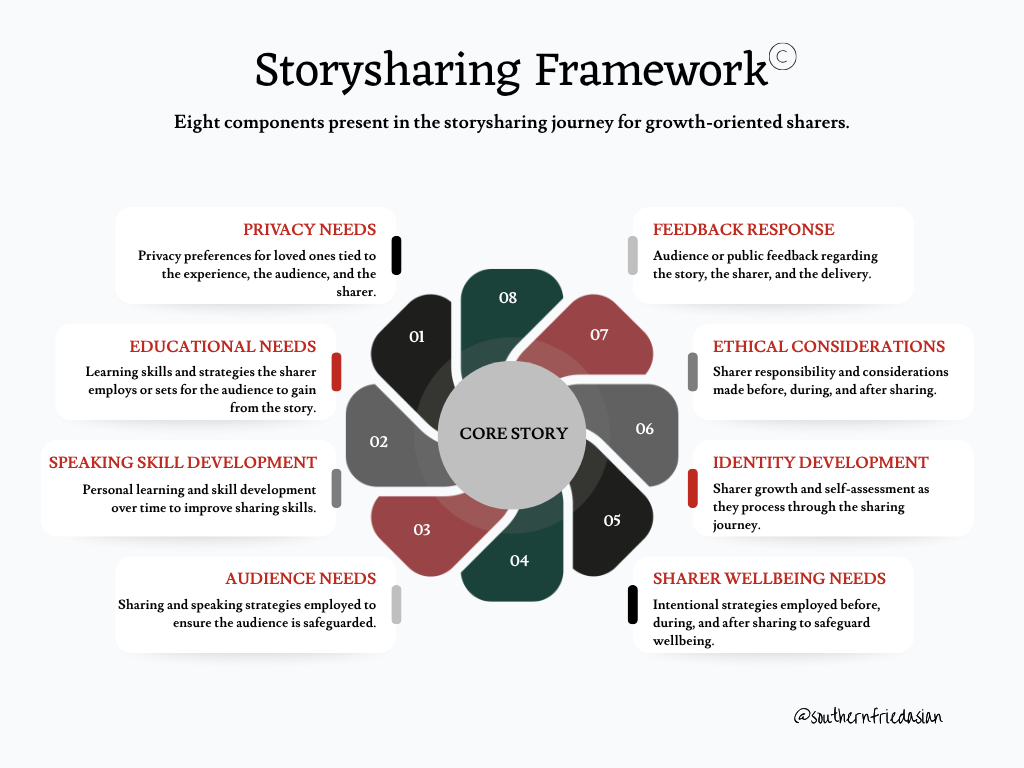
As I have become seasoned, I have wondered what communication processes and sense-making might be found across “sharers,” or those who speak publicly about their personal experiences. I have considered my journey and the lessons I’ve learned and pondered if others have undergone similar learning. Do those of us who share our lived experience narratives engage in similar communication processes? Am I experiencing a journey that is only my own? Can we do a better job of communicating expectations to those who may be new to this arena? Can we provide lessons learned to those considering sharing? Can we positively influence the wellbeing of those who would share? In asking these questions, I realized what I wanted to know was what ethical considerations or best practices should be taken when deciding to disclose publicly.
That is what led me to a journey of trying to understand what I now call the “Storysharing Journey.”© While my research continues, I wanted to share my framework here and let you know I plan to share more so those out there like myself can find healing as they share more of what made you on stage.
Stay well fellow Sharers. We need you.

Leave a comment